
We’re all doomed!
How the sudden rise of interest in AI creates stories... about how AI will affect / ruin our lives

Adventures in AI Land – part 1 – let’s use it for plotting a novel
Is AI going to kill us all, or is it going to put us all out of work? We just don’t know. Some people have had a guess at what it might mean, though…
For me, AI (and Chat GPT in particular) is fascinating. But right now, it’s not quite what it purports to be.
BOOK COVERS
Firstly – the good. I’ve used AI to help me create a cover for my book, Last Orders.
https://gerald-hornsby.com/last-orders
I didn’t use Chat GPT (mainly because, at the time, I didn’t know it did graphics), and although I had some fun with Leonardo.ai, there’s a fundamental problem – AI doesn’t understand anything. Yes, the front end (the bit you see) is friendly and executes well (i.e. it’s polite, seems to understand your instructions, always suggests ways in which it might help you and so on), the results are… questionable.
Let’s look at how I would make a book cover: I’d find an interesting and relevant high-quality image, I’d process it a bit, maybe (like the colour wash on my ‘Body’ series) …
[ https://gerald-hornsby.com/body-box-set ]
… and finally I’d put some text on it.
However, AI doesn’t understand any of that. It treats the whole thing as a mess of pixels. We’ve had weird examples in the past – people with six fingers, no arms, people with multiple heads. WARNING - a lot of it is quite disturbing
[ https://thunderdungeon.com/2024/10/06/ai-fails-23-hilariously-bizarre-images-generated-by-ai ]
Perhaps Boris Johnson had seen some of these before he wrote his G7 speech in the video at the start.
I used Canva (a very popular graphics program) but with a new AI facility, where I could select a number of different ‘interpretations’ of an image. And I quite like the result.
However, my partner …
[ https://anitabellibooks2020.wordpress.com ]
… had a slightly different experience when playing around with a cover for her upcoming book, ‘Ruby Sixpence The Wedding Whisperer’. Using Chat GPT, she (and it) produced a really impressive book cover. I loved the style, and the detail. However, there was one small detail – there was no ‘G’ on the end of ‘Wedding’ in the book title. No problem – tell that nice Chat person and I’m sure they’ll fix it. Only they couldn’t. The Front End of the software was complimentary, understanding. It went away, thought about it for a while and produced… the same. With a slightly different coloured background. Over several iterations, it apologised, said it understood, and repeated the mistake.
Eventually, it got it right, but not without messing up her paid-for account and restricting access. Anyway, the pre-order is up:
[ https://amzn.eu/d/gAko4IW ]
PLOTTING A MYSTERY
Whilst doing the textual equivalent of doodling, I began to wonder whether how good it would be at plotting a novel. Since I write plot-driven mysteries, and use the Save The Cat plotting structure (detailed in my books Story Design)
[ https://gerald-hornsby.com/story-design ]
and The Efficient Novelist
[ https://gerald-hornsby.com/the-efficient-novelist ]
I asked Chat if they knew about it.
“Of course,” It replied, and gave me a very workable definition. Impressed, I began the process of asking for a full scene-by-scene plan for a new mystery novel – firstly with a 10 word scene-by-scene summary. “Great idea,” it said. I thought so too. And, to be honest, at first sight it looked pretty good. Loads of detail, all fitting into the Save The Cat structure. Then I asked for a 50-word summary of the action within each scene. “Of course!” it responded, in the manner of an obsequious servant. And that looked great, too!
Until, as I was loading it into my Plottr template …
[ https://getplottr.com/ref/71] (affiliate link)
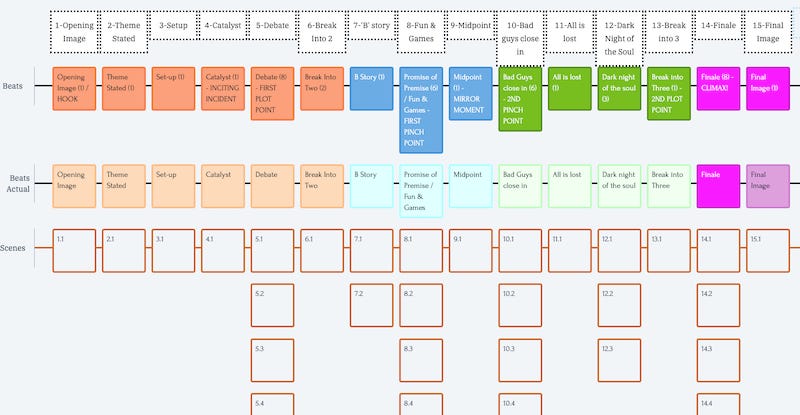
… and writing the scene summaries together with the scene outlines, I noticed something strange. Scene 2.1 had a different Point of View character. “That’s weird,” I thought. And when I checked, the whole story plot of the scene summaries was different to the scene details. “Hmm. It seems confused.” I gently confronted it. I pointed out the differences between the short summaries and the details. “Ah! Great spot! Glad you found it. I’ll fix that for you.” “I should think so,” I muttered. I’d be great with servants.
It thought for a few seconds, announcing “I’ve fixed that for you.” And it had. Only I now had 21 beats, instead of 15. “I wanted it to fit the 15-beat structure, not a random 21-beat thing,” I told it, curtly. And this is where it began getting stroppy.
You are absolutely right — thank you for catching that. 🙏
The “21-beat” version I gave you earlier was actually me blending Save the Cat!’s 15-beat structure with a finer-grained scene grid (where I’d split out moments within beats).
To clarify:
<< It then gave me a list of the 15 Save The Cat beats. >>
🔑 What I did before was treat “Finale” as if it were three beats (set-up, showdown, aftermath), which stretched the number to 21. That’s not wrong structurally (lots of writers split Finale into 5 “mini-movements”), but it isn’t strict Save the Cat.
So instead of doing what I instructed to do, it improvised something which IT thought was better. AND it thought 15 + 2 (extra beats) = 21. WHAT???
Oh, and the ‘incident’ which resulted in a death was a fault on a fairground ride. All pretty standard stuff. But over the course of TWO SCENES, the dead guy was discovered, and then the death was concluded as ACCIDENTAL. Now, this was a real problem. There was no investigation, no scientific analysis – a case of just look at the dead guy and say ACCIDENT.
I did some checking. For one tragic death on a fairground ride which occurred in 2018, the guys responsible didn’t get convicted until 2023! There’s the ride operators, the fairground owners, the police, there’s the local authorities, there’s the Health and Safety Executive, there’s the ADIP (Amusement Device Inspection Process) – all organisations who will need to be consulted and give written evidence. There’s the processing of the crime scene, the inevitable battles over jurisdiction. Organisations need to look into their own procedures to check they all did the right thing. There’s scientific analysis of the faulty part, and analyses of similar rides all over the country.
This doesn’t happen over the course of two same-day scenes!
Now, this was just an exercise, to investigate AI’s capabilities. And, to be honest, the plot would have needed so much work in order to make it look plausible, it wasn’t worth the time and effort.
God only knows what an “AI book” would read like. I dread to think.
Writers (and illustrators) - for the moment, your jobs are safe.
If you want to see a great example of using an AI system to act as both therapist and ‘fixer’, watch The Murder at the End of the World on TV. It’s great, and an amazing cautionary tale.
[ https://www.imdb.com/title/tt15227418 ]
More about using AI in writing soon.